
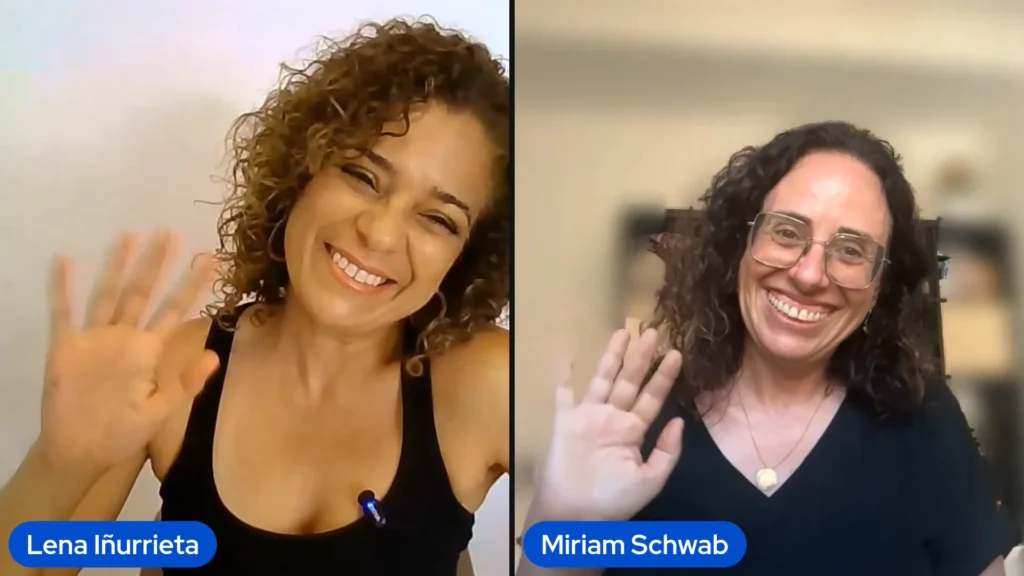
In this episode of Women Leaders in Technology, I had the pleasure of speaking with Miriam Schwab, Head of WordPress at Elementor, entrepreneur, former agency owner, and co-founder of Strattic.
Miriam’s journey is a powerful example of how a career in technology does not always begin with code. Her path started with English literature, content, and copywriting, but her curiosity about websites led her into WordPress, entrepreneurship, cybersecurity, product development, and eventually to a strategic role inside one of the most influential companies in the WordPress ecosystem.
Throughout the conversation, we talked about her beginnings with WordPress, the creation of Strattic, what Elementor is building today, the role of AI in website creation, the recent layoff in Elementor, the future of WordPress, and what it means to be a woman in the tech industry.
You can watch the full episode and read a resume here.
Listen to the full podcast episode here:
How did you start with WordPress?
Miriam began her career working with content, copywriting, and marketing materials. As much of that content ended up on websites, she became more interested in how websites were built and how they could help businesses get better results.
At first, she built static HTML websites. But when clients needed updates, the process became difficult and inefficient. That led her to explore content management systems. She tested tools like Joomla, Drupal, and WordPress, and quickly found that WordPress felt more intuitive and flexible.
At the time, WordPress was still mainly associated with blogging. But when it evolved into a stronger CMS, more companies started seeing it as a professional solution. Miriam was already offering WordPress services, so she was well positioned to grow her work into an agency.
One of the most personal parts of the conversation was when Miriam explained how WordPress gave her flexibility at a stage of life when she had small children. Running her own agency was demanding, but it allowed her to build a business and a career while also having more control over her time.
Building Strattic: Performance, Security, and Scalability
After years of running a WordPress agency, Miriam became deeply familiar with the problems that businesses face behind the scenes: hosting, infrastructure, performance, traffic spikes, and security.
These challenges inspired the idea behind Strattic: allowing users to continue managing their websites in WordPress while deploying a static version of the site for visitors.
The goal was to offer the best of both worlds: the flexibility of WordPress together with the speed, resilience, and security of static websites.
Miriam explained that this approach made it much harder for websites to be hacked or crashed, because the public-facing site did not rely on the same dynamic server and plugin infrastructure. Strattic became especially useful for organizations where performance and security were mission-critical, including large companies, fintech organizations, governments, and international institutions.
Strattic was later acquired by Elementor, bringing Miriam into the Elementor team.
What Does Head of WordPress at Elementor Mean?
Miriam described her role at Elementor as a dynamic position that connects the company with the broader WordPress ecosystem.
Elementor is used by many different types of people and organizations, and its users often overlap with hosting companies, plugin developers, agencies, freelancers, and other WordPress businesses. Miriam’s role includes helping Elementor maintain strong relationships across that ecosystem, supporting partnerships, understanding compatibility issues, and ensuring that shared users have a better experience.
She also spoke about her long history in the community: organizing WordCamps, speaking at international events, and being actively involved in the WordPress world for many years.
Elementor, No-Code, and the Evolution of Website Building
During the interview, Miriam explained Elementor as a visual, no-code website builder for WordPress. Its original purpose was to help people design and build websites without needing to know how to code.
She also talked about Elementor’s broader product direction, including additional tools such as image optimization, accessibility, cookie consent, reliable email delivery, and AI-powered website creation through Angie, Elementor’s AI assistant for WordPress.
Angie AI and the Future of AI in WordPress
A major part of the conversation focused on Angie, Elementor’s AI product for WordPress.
Miriam explained that AI should not be added to products just for the sake of adding AI. The value is in helping users do things they could not do before, or making difficult tasks easier.
Angie is designed to sit next to users inside their WordPress site, allowing them to interact with their website through natural language. Instead of manually connecting APIs or using external tools in a fragmented way, users can install a plugin and start working with AI directly in the WordPress environment.
Miriam also addressed the cost of AI. While AI infrastructure can be expensive, she believes the market will evolve, costs will become more controlled, and the value for users will justify reasonable pricing when AI helps them offer better services or complete more advanced work.
Does Elementor Create Technical Dependency?
We also discussed a common criticism around plugins and visual builders: the idea that using a tool like Elementor creates technical dependency.
Miriam’s answer was clear: almost every tool creates some form of dependency. If you use WordPress, a hosting provider, a CMS, a SaaS platform, or a closed website builder, you are depending on some technology.
For her, one of the strengths of WordPress is that it still gives users choice. People can use Elementor if it brings them value, use other tools if they prefer, or combine different approaches. That freedom of choice is part of what makes the WordPress ecosystem powerful.
Scaling Products in the WordPress Ecosystem
Miriam also reflected on what it means to scale a product in WordPress.
The open-source ecosystem offers enormous distribution, but it also comes with challenges. For example, commercial plugins can be copied or pirated, and companies must constantly work to keep growing, improving, and delivering value.
She emphasized that scaling is never easy. There is no magic trick. Companies have to keep listening to users, adapting to changes, and working hard over time.
WordPress in the Age of AI and Vibe Coding
One of the most interesting parts of the interview was the discussion about the future of WordPress in a world of AI tools, no-code platforms, closed ecosystems, and “vibe coding.”
Miriam believes that WordPress still has strong advantages, especially for projects that need structure, ownership, flexibility, extensibility, and long-term growth.
AI-generated sites and lightweight tools may be useful for simple projects, quick landing pages, or small applications. But for organizations that need to build, extend, control, and evolve their digital presence, WordPress still has an important role to play.
However, she also made it clear that WordPress needs to move quickly. The ecosystem must become more AI-first and make it easier for users to benefit from AI inside WordPress.
Will Humans Still Visit Websites?
We also talked about a big question for the future: if AI agents and bots increasingly search, compare, and retrieve information for us, will humans still visit websites?
Miriam believes design will still matter.
She explained that websites have always had two audiences: humans and machines. First, we optimized for Google and search engines. Now, we also need to think about AI agents and bots. But that does not mean human experience disappears.
People still want to understand the brand, the trustworthiness, the people, and the feeling behind a business. A purely chat-based experience would be boring and uninspiring. Websites will still need to create trust, communicate identity, and offer a meaningful experience.
Her point was not that design will disappear, but that the bar will be higher. With AI making creation easier, websites will need to become better, more differentiated, and more useful.
Being a Woman in Tech
In the final part of the interview, Miriam spoke openly about her experience as a woman in the technology industry.
She shared that she has often felt underestimated or undervalued, and that she had to work harder to be recognized as an authority. She remembered being in rooms where men who were newer to the space were quickly treated as leaders, while she had to prove herself repeatedly.
She also shared a powerful example from her time building Strattic. In investor meetings, people often assumed that her male co-founder was the technical person, when in fact Miriam was the technical founder. Her co-founder would redirect technical questions back to her, making it clear that she was the person to answer them.
At the same time, Miriam also acknowledged that many men supported her journey, believed in her, and helped her build her company. Her experience shows both sides of the industry: the bias that still exists, and the importance of allies.
Her advice to women in tech is to remember that their voice matters. Speaking up may not always feel natural, especially when dealing with imposter syndrome or lack of confidence, but it is important. Over time, consistently sharing thoughtful ideas helps others recognize your expertise and authority.
Miriam also continues to support women in technology by speaking to students, helping women entrepreneurs, mentoring women founders, and supporting women inside her company and the wider WordPress community.
Final Thoughts
This conversation with Miriam Schwab is not only about WordPress, Elementor, AI, or security. It is also about building a career with curiosity, adapting to change, creating products that solve real problems, and finding your voice in an industry where not everyone is heard equally.
Miriam’s story shows how WordPress can be more than a tool. It can be a path into entrepreneurship, leadership, community, and innovation.
And as AI changes the way we build and experience the web, her message is clear: the tools will change, the workflows will evolve, but people, creativity, trust, and community will still matter.
Listen to the full podcast episode here:
Guest: Miriam Schwab
Topics: WordPress, Elementor, Angie AI, Strattic, cybersecurity, open source, women in tech, website design, future of the web.

